There are traders who became famous due to winning competitions, inventing indicators, managing large funds, or having lucky years. Robert Pardo became known for changing the way trading strategies are optimized and tested. And he gained further fame for the trading systems that he developed over the last 30 years for large investment firms. His latest development, Ranger, produced spectacular returns in the past years, despite the turbulent markets. Is this the one system to rule them all?
I knew Robert Pardo as the author of a well known trading book that’s also mentioned in Zorro’s book list. Long before algorithmic trading was widely used, Pardo was thinking about the practical problems that every system developer still faces today: How can you distinguish a robust trading system from a system that has a beautiful backtest, but will go belly-up when exposed to the live market? Pardo’s solution, described in his book, was Walk-Forward Analysis. The idea sounds almost obvious: Optimize a system on one segment of historical data, test it on the next unseen segment, roll the whole window forward, and repeat the process. But this turned what previously was a kind of black art, needing experience and intuition, into a repeatable engineering process.
From Software Pioneer to System Designer
Pardo built some of the early software tools for technical analysis and trading system development. His platforms, such as Chartist and Swing Trader, were part of the prehistory of today’s algorithmic trading platforms such as TradeStation or Zorro. His book, The Evaluation and Optimization of Trading Strategies, became a classic because it addressed the uncomfortable part of trading system development: not how to generate signals, but how to know whether those signals deserve trust.
Using his experience and his development process, Pardo provided algorithmic strategies and consulting to large firms such as Goldman Sachs, Daiwa Securities, Transworld Oil, and DUNN Capital. His systems XT99 Diversified and Pardo Renaissance Diversified systems proved consistently profitable over the years. XT99 alone has been cited over 30 times for excellence and top performance, and made – according to Pardo – millions of dollars for its users. Ranger is the final consequence of his trading philosophy.
What Ranger Is — and What It Is Not
Superficially, Ranger is a strategy script for TradeStation. But calling Ranger “a strategy” is somewhat misleading. Ranger is better understood as a strategy generator.
It is built around a classic idea: the range breakout. The simplest version of a range breakout buys when price exceeds the highest high of the last n bars and sells when price breaks below the lowest low of the last n bars. This idea goes back to Richard Donchian’s four-week breakout system and later became famous in a generalized form through the Turtle Trading system.
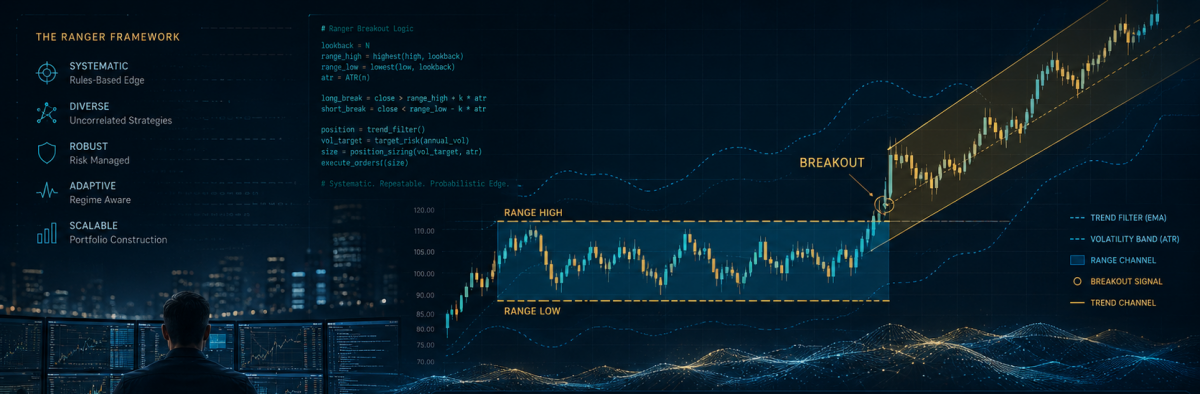
Ranger starts there. But instead of giving the trader a fixed breakout model, Ranger offers many switches and variables that change the nature of the system. A Ranger strategy can trade breakouts, pullbacks, with the trend, against the trend, or only when the market is moving sidewards. It can use volatility filters, entry filters, exit orders, profit targets, risk stops, and trailing stops. With different combinations of those elements, Ranger can produce thousands of structurally different strategies.
That is the central idea: not one magic system, but a factory for generating robust systems.
The Portfolio Concept
One of the interesting aspects of Ranger is not any single indicator or rule, but the portfolio idea. A trader can try to build the perfect strategy for a particular market. That is the traditional approach. Ranger uses a different approach: build a family of strategies whose logic differs enough that they do not all make and lose money at the same time.
This is especially relevant for single-market portfolios. If ten strategies all buy the same breakout and use the same exit, they are not really ten strategies, but ten incarnations of one strategy. Ranger tries to avoid that by offering structural variation: stop versus limit entry, with-trend versus counter-trend logic, volatility regimes, trend-neutral modes, and different exit behavior.
This is where Pardo’s background becomes visible. Ranger is not just a clever signal generator. It reflects the thinking of someone who spent decades worrying about validation, robustness, and the difference between a strategy that looks good in a particular backtest and a strategy that really survives all sorts of market regimes.
RangerZ – the Zorro Version
Robert Pardo contacted us last year for creating a Zorro variant of his Ranger system. RangerZ had to replicate the components, variables, and trading behavior of Ranger, but take advantage of Zorro’s superior speed, optimizing, and analysis functions. My colleague Petra took over the development, and recently wrote an article about it.
I became quickly conviced of Ranger’s flexibility and proven performance. But I was, for various reasons, not so convinced of the ‘Rangermaker’ tool that Robert Pardo uses to evaluate Ranger strategies and build Ranger portfolios, even though they had an impressive track record. That’s why we decided not to replicate this tool and its evaluation process, but developed our own one last year, the Evaluation Shell.
The Shell converted RangerZ from a manual strategy laboratory to an automated research environment. The setup consists of jobs, variables, assets, time frames, and algorithms. A job defines a particular combination of Ranger variables; Zorro then trains and tests that configuration with all assets and time periods. After further analysis steps, a final portfolio is created. All these processes run fully automated, only at the last stage the user can pick the most uncorrelated strategies by their equity curves from a preselected set. The basic portfolio included in RangerZ results from this process.
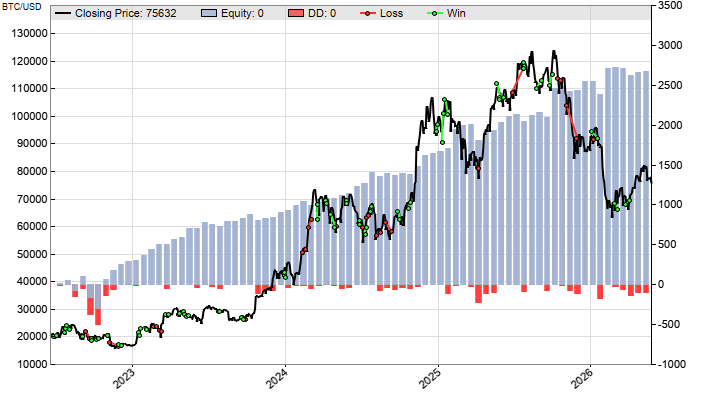
The important point is that RangerZ does not merely translate Ranger from EasyLanguage to C. It embeds Ranger in a full development workflow. Strategies can be compared by their individual equity curves, filtered by cluster analysis, and finally subjected to a Monte Carlo reality check. Although this concept is not reviewed or approved by Robert Pardo, it fits very well with his philosophy: a trading system should not be trusted because its backtest looks good, but because it has survived a disciplined validation process.
RangerZ also makes the Ranger idea more accessible to systematic experimentation. Variable settings can be stored as CSV job files, reused, modified, and combined. Users can begin with the included jobs, then create their own combinations of markets, time frames, trend modes, entry types, volatility filters, exits, stops, targets, and position-sizing rules. Asset lists can be freely defined, so the strategy architecture can be applies to various asset types – CFDs, ETFs, or futures – based on the same markets such as indexes, commodities, or bitcoin.
In that sense, RangerZ is a natural continuation of Pardo’s work. Ranger supplied the strategy architecture. Zorro supplies the engineering machinery around it. Together they turn Ranger from a powerful strategy toolbox into a complete research and development system that can generate almost any sort of strategy.
The old dream of traders was to find the one perfect system. Ranger’s approach is more realistic: Build many good systems, test them properly, and combine them to the final robust portfolio that rules them all.
Johann, would this system normally operate on a single broker plugin at a time, or are there provisions for multi-plugin configurations?
You can use different brokers for different assets, by editing their symbols in the asset list.
That’s just my silly interpretation of things and not my business but the undertones does sound a bit like “those damn Germans coming in again with their fine machinery and ruining everything” to me. Thanks for the article.
What was the problem with the tools and processes that Robert Pardo used?
I am not permitted to tell since unlike ours, Pardo’s process is not public.
Was the Evaluation Shell inspired by RangeMaker?
It was insofar inspired as we wanted a product like RangerMaker, but with a different process and user interface.
Regarding the Arnis comment – far from it. I never allowed Johann to see the full process. I have been at this for some time now and I am always open to new, valuable, proven ideas. The few ideas that Johann talked about added no value.
Regarding the Marquart comment – there is NOTHING wrong with our PROVEN process. Johann is talking about a chimera. He does not know what it is.
It is fully implemented in our new product Ranger Prime and our new audio-visual program currently under development.
See the track record produced by Excalibur and its predecessors.
XT99 – https://www.pardo.space/xt99-diversified-1
Pardo Renaissance – https://www.pardo.space/pardo-renaissance-diversified
Current – https://www.pardo.space/current-performance
Our history – https://www.pardo.space/history-1
Regarding the Dolder comment – Yes, the RangerZ is an automated implementation of parts of the RangerMaker process. RM is a piece of the Excalibur process. RangerZ is lacking much of the technology of Excalibur.
Regarding WFA – Yes, most discoveries are “obvious” after they have been discovered. I guess Lotter should be happy that I did invent it since WFA is central to his evaluation process.
Regarding the Marquart comment – There is nothing “wrong” with our process. Lotter is tilting at windmills. He does not know our Excalibur process . The proven performance of Excalibur and its predecessors can be fully seen on our website. Apparently either Lotter or some filter does not permit links in a comment. If you are interested take a look at XT99, Pardo Renaissance, Current Performance and our History. All a part of algo history.
Regarding Bob’s comments – thank you for posting! Well, I can only judge what I know – and that’s your evaluation process for Ranger, and your Rangermaker tool that you sent me for replicating the process. If you have another process, I don’t know it.
I can understand that you are defending your tool and process. I also understand that my objections against parts of them, and my improvement suggestions, have been unwelcome. After all, I’m no famous trader and my objections were just based on dry math. So let’s agree that we disagree here. The suggested improvements are done, in the form of our evaluation shell, and we both have a fine product. Let’s make the best of it.
– Bob, you can post links, but then your comment needs approval by an editor.
trading IV on options does not work anymore. need a new strategy
We can do any options strategy for you, but this article was not about trading IV on options.